
Your left turn signal works on the truck and does nothing on the trailer. Or the hub is too hot to touch at a rest stop. Or you just bought a used landscape trailer with no title and no idea what your state wants from you. That is the moment Tongue and Axle exists for.
Trailer fixes and rules, explained like a neighbor who owns the shop. That is the whole idea. No hype, no filler, no ten ads between you and the torque spec you actually came for.
We cover small and mid-size utility, landscape, enclosed cargo, dump and car-hauler trailers in the US and Canada: wiring and lights, hitches and couplers, brakes, bearings and tires, loading and weights, and the rules per state and province.
The mission
Why this site exists
Most trailer advice online falls into two buckets. The first is a forum thread from years ago where five people argue about wire colors. The second is a product page pretending to be a guide. Neither one helps you at 9 pm with a test light in your hand.
The mission here is simpler. Give the trailer owner the same answer a good shop would give across the counter: the most likely cause first, the cheapest fix first, and a straight answer about when a job is over your head.
A trailer is not mysterious. It is a frame, an axle, some wiring and a coupler, all of it wearing out at a predictable rate. Once someone explains the system, most of it is driveway work with basic tools. The rest of it is knowing your limits, and we will tell you plainly where those limits are.
What you can count on here
- Every how-to starts with the most likely cause and the cheapest fix, then works up to the rare ones. You stop guessing with your wallet.
- Wiring articles include pinout and color code tables for the 7-way RV blade and the 4-flat, so you match the standard instead of folklore.
- Rules coverage names the state or provincial agency that publishes each requirement and tells you to confirm with that agency before you tow.
- Weights are given in lb with kg in brackets where Canada applies, and US terms come with the Canadian equivalent, so one article works on both sides of the border.
- Parts are recommended by type and specification, such as bearing number, ball size, wire gauge and controller type, never by hype.
- Safety guidance is blunt: wheels chocked, frame on jack stands, and a plain no when a trailer should not be towed with that vehicle.
The approach
How every guide is built
Every article opens with a concrete situation. A dead left turn signal. A coupler that will not latch on a 2 inch ball. Brakes that lock up in a parking lot but do nothing on a hill. You came with a problem, so we start with your problem, not with a definition of what a trailer is.
Then comes the order of operations. Cheapest and most common cause first. For a one-sided light problem, that means checking the bulb and the ground on that side before anyone mentions a converter box or a corroded 7-way. Each step names the exact check and the tool: a test light, a multimeter, a torque wrench set to the right ft-lb.
Numbers are real numbers. Wire gauge, not just heavier wire. Ball size, not just the right ball. Tongue weight as a percentage of trailer weight, not just keep the heavy stuff forward. If a range depends on your state or province, we say so instead of pretending one number fits all.
Parts get recommended by specification. A bearing number that matches your spindle. A controller type that matches your brake system. A wire gauge that matches the circuit load. Sometimes the cheap part is fine, and we say so. Sometimes the cheap part is how you end up on the shoulder, and we say that too.
And some jobs are not driveway jobs. Welding a cracked frame, setting up weight distribution on a marginal tow vehicle, anything that keeps you guessing under a loaded trailer: we will tell you to pay a shop. That is not an upsell. It is just true.
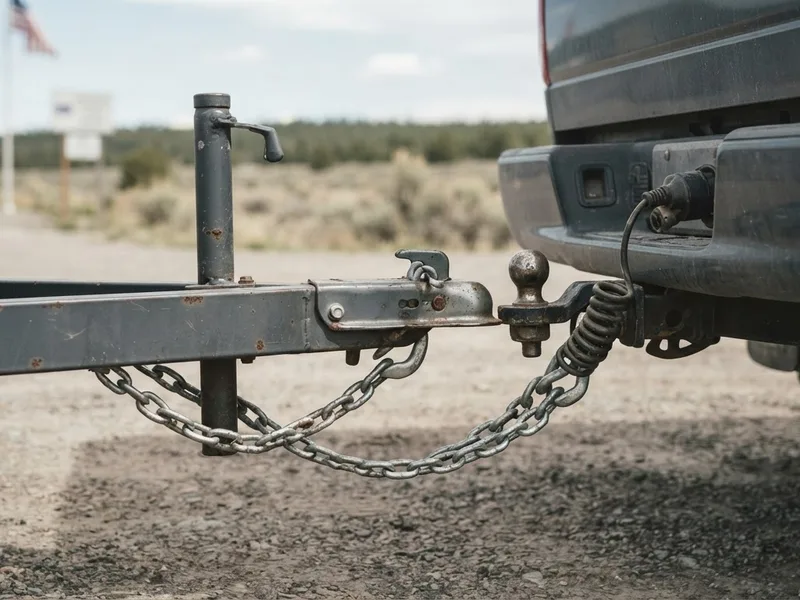
Both sides of the border
Towing rules change at the border, and sometimes at the state or provincial line you crossed an hour ago. Brake requirements, plate rules and inspection schedules are set by each state and province, and they do not match.
So we write for both countries at once. Weights come in lb with kg in brackets where Canada applies. US terms get the Canadian equivalent, and Canadian terms get the US one. One article, no conversion math on your tailgate.
Rules coverage names the agency that publishes each requirement, whether that is a state DMV, a state patrol or a provincial transport ministry. Agencies change their rules, so we always tell you to confirm with that agency before you tow. We explain the rule, we do not replace it.
Who it serves
Who this site is for
You own a utility, landscape, enclosed cargo, dump or car-hauler trailer. It lives in your driveway or behind your shop. It hauls mowers, ATVs, lumber, a project car or the occasional load of gravel.
You tow with a pickup, an SUV or a crossover, and you fix things yourself, or you want to understand the problem before you pay someone else to fix it. You are not looking for a lecture. You are looking for the check, the order and the tool.
You might be dealing with a 4-flat to 7-way mismatch after buying a different trailer. A hot bearing an hour from home. Brakes that either grab or give you nothing. A used trailer without a title. Or a state or provincial line that changes the rules on brakes, plates and inspections, and you want to know before the weigh station does.
If that sounds like your situation, this site was written for you. If you run a commercial fleet with air brakes and logbooks, some of this still applies, but that is not who we are writing to.
How to use the site
Get from problem to fix
Start with the symptom
Every guide opens with the problem you actually have, like a dead light on one side or a hub that is hot to the touch. Find the article that matches your situation and start there.
Work the cheap fixes first
Each guide moves from the most likely cause and the cheapest fix up to the rare and expensive ones. Most trailer problems quit long before the expensive part of the list.
Match the spec, not the brand
When you need a part, buy by specification: bearing number, ball size, wire gauge, controller type. Our guides give you the numbers so the counter person cannot sell you the wrong thing.
Confirm the rules where you tow
Brake, plate and inspection rules come from your state or provincial agency. Read our plain-language summary, then confirm with the named agency before you hit the road.
Got a trailer problem we have not covered?
If you are stuck on something and the site does not answer it yet, send it in. Real reader problems are how new guides get chosen, so the weirder the symptom, the better.